|
RELATED PAGES What Is an Argument? | The Lego Model | Background Paragraphs | Argumentative Paragraphs | Example Paragraphs | Topic Sentences |
Putting the Pieces Together
Two tools turn the components of an argument into a structure a reader can follow: a debatable thesis statement and effective topic sentences.
In What Is an Argument?, you saw what an argument needs: a claim, reasons, analysis, evidence, and examples. Having those components is a start, but a reader will only be persuaded if they can see how the components fit together. Building that structure takes two tools.
The first tool is a debatable thesis statement. Your thesis statement is where you state your claim, and a debatable thesis is what makes the claim work. When your thesis takes a position a reasonable person could dispute, every reason, piece of evidence, and example that follows has something to prove.
The second tool is the topic sentence. Topic sentences make the connections between the ideas in your text. Each one tells the reader what a paragraph is doing and how it relates to your topic, your claim, or another paragraph, so the reader understands how the different parts of the text work together.
Argumentative Thesis Statements
An argumentative thesis statement meets the same four criteria as any thesis statement, plus a fifth: it must be debatable.
Your argumentative thesis statement should meet these five criteria:
- Last sentence in the introduction (structure): Your thesis statement is the last sentence of your introduction paragraph.
- One sentence long (structure): Your thesis statement presents your main idea or claim in a single sentence.
- Specific (content): Your thesis statement uses terminology that points the reader to one particular idea.
- Concise (content): Your thesis statement is free of unnecessary words or phrases.
- Debatable (content): Your thesis statement presents a claim that has more than one reasonable answer.
For a full discussion of the first four criteria, see Lecture Notes: Mastering Thesis Statements.
Debatable
A debatable thesis statement presents a claim that a reasonable person could challenge. A fact, on the other hand, can be checked and settled. Once a fact is confirmed, there is little left to discuss, so a thesis statement built on a fact gives your paper or essay nothing to prove.
|
?
|
THE QUESTION TEST |
To check whether your thesis statement is debatable, turn it into a question. If the question has only one legitimate answer, your thesis statement is a fact. If it has two or more legitimate answers, your thesis statement is debatable.
| Thesis Statement | As a Question | Possible Answers | Result |
| There is oxygen in Earth’s atmosphere. | Is there oxygen in Earth’s atmosphere? | Only yes. | Fact |
| Mustangs are the best sports car. | Are Mustangs the best sports car? | Some readers will say yes. Others will say no. | Debatable |
|
!
|
COMMON MISTAKES TO AVOID |
1. Putting the question in your paper or essay. Avoid putting your question into the draft of your paper or essay. The question is only a test for debatability. You are writing a thesis statement, not a thesis question. Run the test on scratch paper or in your head, but keep your current draft as a statement
2. Skipping the test. Some claims sound debatable but turn out to be facts, so feeling sure about a thesis statement is not the same as testing it. A single word or phrase can be enough to make a thesis statement debatable or not debatable. Here are two kinds of wording that are easy to miss:
- “Can,” “could,” or “will”: “Smaller class sizes can help student academic performance” becomes “Can smaller class sizes help student academic performance?” They can. It is possible, and no one can show that it is impossible, so the question has only one answer.
- “I think” or “I believe”: “I believe Mustangs are the best sports car” becomes “Do I believe Mustangs are the best sports car?” The only answer is yes, since the writer cannot claim not to believe what they just said they believe.
These are not the only examples of wording that can turn a claim into a fact, which is why you should run the question test on every draft of your thesis statement, even when you feel sure. Here are some examples:
| Thesis Statement | As a Question | Possible Answers | Result |
| Smaller class sizes can help student academic performance. | Can smaller class sizes help student academic performance? | Only yes. | Fact |
| I believe Mustangs are the best sports car. | Do I believe Mustangs are the best sports car? | Only yes. | Fact |
| Smaller class sizes improve student academic performance. | Do smaller class sizes improve student academic performance? | Some readers will say yes. Others will say no. | Debatable |
Sample: Connecting the Pieces
Topic sentences signpost and connect parts of your paper or essay so readers can see the structure of your argument.
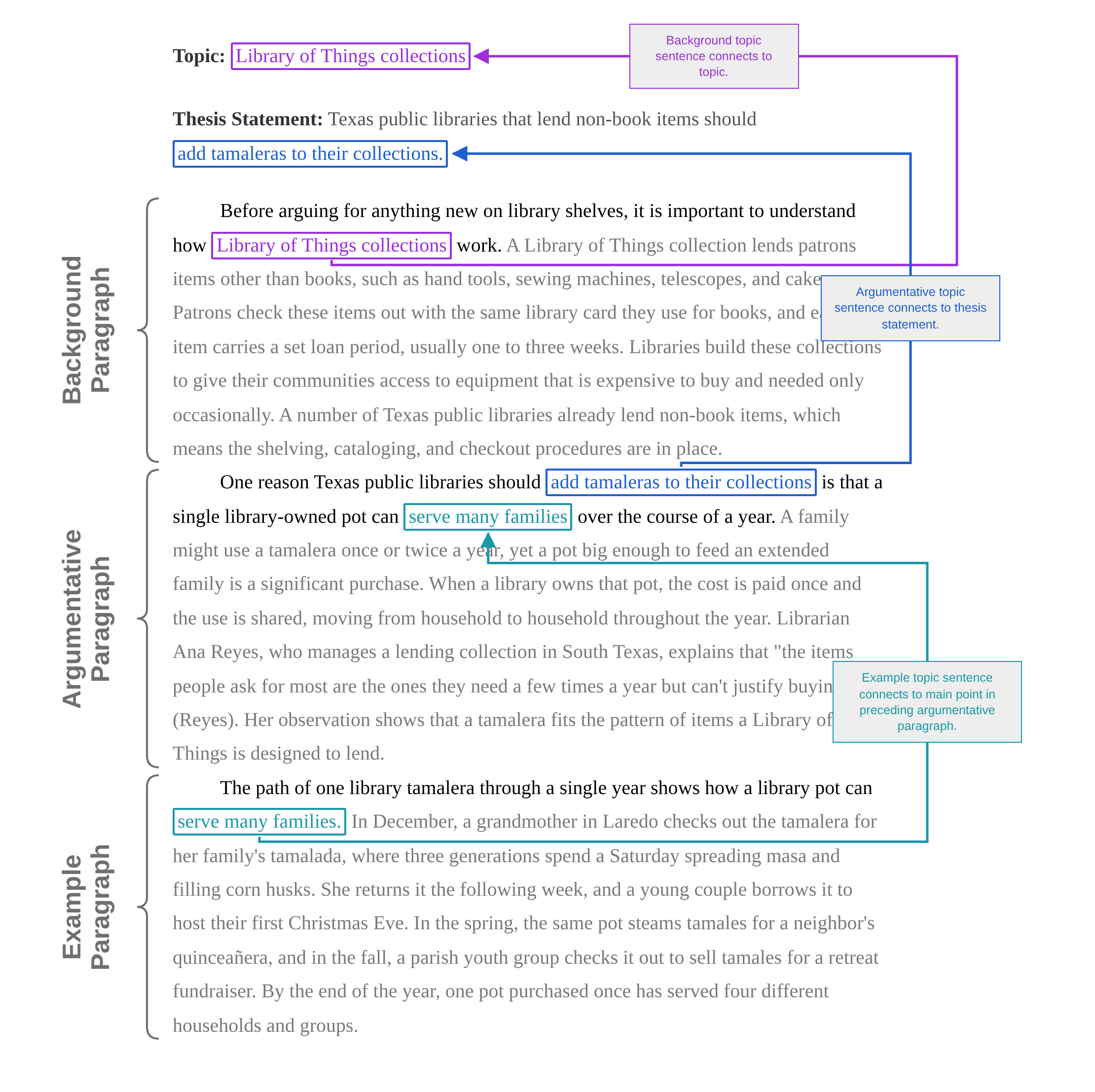
Each type of body paragraph connects in a different way. A background paragraph’s topic sentence connects to the paper’s topic. An argumentative paragraph’s topic sentence connects to the thesis statement. An example paragraph’s topic sentence connects to the main point of the argumentative paragraph before it. When every topic sentence makes its connection, a reader can trace how each paragraph serves the argument.
To see these connections at work, we return to Jordan’s paper in progress from What Is an Argument?. He has his claim and his brainstorm, and now he is drafting his paper.
JORDAN’S PAPER
Topic: Library of Things collections
Thesis Statement (first draft): I believe Texas public libraries that lend non-book items could add tamaleras to their collections.
Thesis Statement: Checking That It Is Debatable
Before Jordan writes a body paragraph, he runs the question test on the first draft of his thesis statement. As a question, it becomes “Do I believe Texas public libraries that lend non-book items could add tamaleras to their collections?” Jordan does believe it, so the only answer is yes. The phrase “I believe” has turned his claim into a fact. He deletes it and runs the test again:
“Texas public libraries that lend non-book items could add tamaleras to their collections.”
This time the question is “Could Texas public libraries that lend non-book items add tamaleras to their collections?” They could. It is possible, and no one can show that it is impossible, so the only answer is still yes. So his thesis statement is still a fact.
Jordan thinks more about what he wants to argue for. He realizes he’s proposing that libraries add these items to their inventories. He wants to argue that they should take this action, so he replaces “could” with “should,” and runs the test a third time. Now the question is “Should Texas public libraries that lend non-book items add tamaleras to their collections?” Some readers will say yes, for the reasons Jordan plans to argue. Others will say no.
Because the question has two or more legitimate answers, Jordan knows his revised thesis statement is debatable, and that his paper has something to prove. He puts the statement version, not the question, at the end of his introduction:
JORDAN’S PAPER (REVISED)
Topic: Library of Things collections
Thesis Statement: Texas public libraries that lend non-book items should add tamaleras to their collections.
Background Paragraph: Connecting to the Topic
Many of Jordan’s readers have never heard of a Library of Things, so he needs to explain what one is before he can argue that it should hold tamaleras. His background paragraph’s topic sentence names his topic, Library of Things collections, and tells the reader that context is coming.
Before arguing for anything new on library shelves, it is important to understand how Library of Things collections work. A Library of Things collection lends patrons items other than books, such as hand tools, sewing machines, telescopes, and cake pans. Patrons check these items out with the same library card they use for books, and each item carries a set loan period, usually one to three weeks. Libraries build these collections to give their communities access to equipment that is expensive to buy and needed only occasionally. A number of Texas public libraries already lend non-book items, which means the shelving, cataloging, and checkout procedures are in place.
Argumentative Paragraph: Connecting to the Thesis
With the context in place, Jordan begins arguing. His argumentative paragraph’s topic sentence repeats a phrase from his thesis word for word, add tamaleras to their collections, so the reader knows which claim the paragraph supports. The same sentence states his main point, the reason this paragraph argues: a single pot can serve many families.
One reason Texas public libraries should add tamaleras to their collections is that a single library-owned pot can serve many families over the course of a year. A family might use a tamalera once or twice a year, yet a pot big enough to feed an extended family is a significant purchase. When a library owns that pot, the cost is paid once and the use is shared, moving from household to household throughout the year. Librarian Ana Reyes, who manages a lending collection in South Texas, explains that “the items people ask for most are the ones they need a few times a year but can’t justify buying” (Reyes). Her observation shows that a tamalera fits the pattern of items a Library of Things is designed to lend.
Example Paragraph: Connecting to the Main Point
Jordan’s main point is still abstract, so he follows it with an example paragraph that shows it in action. The topic sentence names his example, the path of one tamalera through a single year, and repeats the language of the main point it illustrates: serve many families.
The path of one library tamalera through a single year shows how a library pot can serve many families. In December, a grandmother in Laredo checks out the tamalera for her family’s tamalada, where three generations spend a Saturday spreading masa and filling corn husks. She returns it the following week, and a young couple borrows it to host their first Christmas Eve. In the spring, the same pot steams tamales for a neighbor’s quinceañera, and in the fall, a parish youth group checks it out to sell tamales for a retreat fundraiser. By the end of the year, one pot purchased once has served four different households and groups.
The Finished Draft
Here is what Jordan’s draft looks like with every connection marked. Each topic sentence points back to the part of the paper it supports, and together they show a reader how the whole argument fits together.
The sources in this sample are invented for this example. Do not cite them.
Next Steps
Now that you know how the pieces of an argument fit together, put them to work in your own paper: Prep Guide: Argumentative Paper on Addiction.