|
RELATED PAGES The Lego Model | Body Paragraphs | Topic Sentences | Topic Sentences: Varsity Level | Argumentative Paragraphs | Example Paragraphs |
What Is A Background Paragraph?
Background paragraphs provide necessary context to help readers fully engage with your argument or discussion.
Purpose: The function of a background paragraph is to provide context via information about key concepts, historical details, or critical background information, usually about the primary topic. For this reason, background paragraphs most often support the paper or essay topic, not the claim put forward in the thesis statement.
Placement: Background paragraphs often appear immediately following the introduction of your essay or paper, because the writer wants to make sure the reader is aware of certain information before diving deeper into the discussion. They may also come later, just prior to an argumentative paragraph that introduces a particularly complicated or hard to understand main point. In those cases, the background paragraph contextual information is about the main focus or reason of the argumentative paragraph that follows the background paragraph.
Paragraph Structure
“Beef Stew”
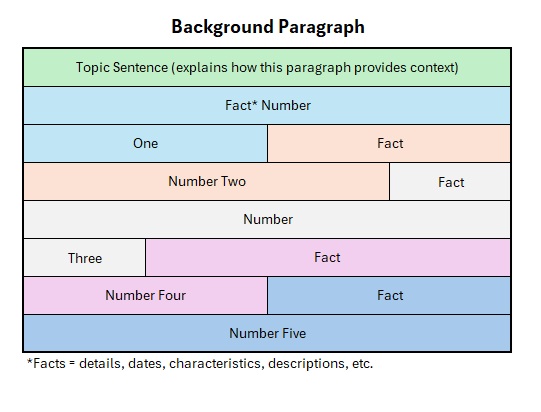
Background paragraphs have the loosest structure of the three body paragraph types since they tend to include varied facts and information.
Like every body paragraph, a background paragraph opens with a topic sentence, and this one has two jobs: 1) signpost for your reader that the focus of this paragraph is to provide background, and 2) to help the reader more fully understand the topic by providing additional context information.
The kinds of facts, dates, data, and statistics you include in a background paragraph are highly dependent on the topic you’re writing about. A biographical paper or essay may have more dates, places, and names, while a paper on a scientific process may have more technical terms, jargon, and mathematical details. When writing your paper or essay, consider what the reader needs to know to understand the topic, then choose your context information based on that point of view.
Regardless of the information you decided to include, context within a background paragraph is rarely presented in a logic-driven order, like the parts of an argumentative paragraph. Similarly, information in a background paragraph does not typically follow a chronological, process, or cause-and-effect sequence, like in an example paragraph. This is why I call background paragraphs “beef stew”: to build context, you’re throwing a bunch of different ingredients into one pot, and there’s no rule that the carrots go in before the potatoes.
Key Insight: When you make beef stew, you don’t use every ingredient in your pantry. A stew is a specific set of ingredients chosen because they taste good when used together. Your research will turn up far more context than your reader needs, so the real work here is selection. Include the key info your reader needs in order to understand the topic, and leave the rest out.
Sample Background Paragraph
ALICIA’S PAPER
Topic: women’s suffrage
Thesis statement: The 19th Amendment was a crucial step forward for women’s rights.
Her research turned up plenty: the Seneca Falls Convention in 1848, decades of state-by-state campaigns, rival suffrage organizations that disagreed on tactics, protesters arrested outside the White House, and Tennessee casting the deciding vote for ratification. Out of all of it, she picked four facts:
| F1 | “Suffrage is the right to vote, and the women’s suffrage movement was the long campaign to secure that right for American women.” Rationale: She knows many readers will not know what the word suffrage means, so its important to explain it right at the start. |
| F2 | “That campaign began in earnest in the 1840s and moved slowly, because the Constitution left voting rules up to individual states, which meant the same argument had to be won state by state, over and over, for roughly seventy years.” Rationale: This explains the shape of the entire movement. A reader who doesn’t know voting rules belonged to the states has no way to understand why winning the vote took seventy years. |
| F3 | “Suffragists pushed from every direction they could: holding conventions, gathering petitions, campaigning for state ballot measures, lobbying legislators, marching, and picketing the White House.” Rationale: Since her paper discusses the process through which women gained political influence, readers need a picture of what that organizing actually looked like. |
| F4 | “Their efforts finally reached the federal level in August of 1920, when the 19th Amendment was ratified, making it illegal to deny someone the vote on account of gender.” Rationale: This sentence gives readers a destination, and it introduces the 19th Amendment itself, which readers have to learn about to understand Alicia’s claim. In fact, she’s decided to write a second background paragraph about the 19th Amendment, since she can see how it is important to her discussion also. |
Here is the paragraph she wrote.
| Topic sentence job one |
Green marks the part of the sentence that signals the paragraph’s main focus: context is coming. |
| The topic job two |
Yellow marks the part of the sentence that connects elsewhere in her paper. In this case, her name-check’s her paper’s topic. |
| F1 – F4 | Her four chosen facts, each shaded to match the diagram above. |
Before getting into the argument, some context on women’s suffrage will help. Suffrage is the right to vote, and the women’s suffrage movement was the long campaign to secure that right for American women. That campaign began in earnest in the 1840s and moved slowly, because the Constitution left voting rules up to individual states, which meant the same argument had to be won state by state, over and over, for roughly seventy years. Suffragists pushed from every direction they could: holding conventions, gathering petitions, campaigning for state ballot measures, lobbying legislators, marching, and picketing the White House. Their efforts finally reached the federal level in August of 1920, when the 19th Amendment was ratified, making it illegal to deny someone the vote on account of gender.
Look at that first sentence again. The green is job one: it tells the reader plainly that context is coming, which is what identifies the paragraph’s main focus. The yellow section does job two: women’s suffrage is her paper’s topic, repeated word for word, which is what ties this paragraph to the rest of the paper.
The four facts that follow aren’t a timeline. Each one answers a different question a reader would have. What is this? Why was it hard? What did people do about it? How did it end? That’s also why the order is flexible. She could move the sentence about conventions and petitions ahead of the sentence about state-by-state campaigns and the paragraph would still hold together, which is the loose structure of beef stew in practice.
Notice what’s missing, too. Nothing here argues that the amendment was crucial, because that’s the job of the argumentative paragraphs that follow.
Next Steps
Background sets the table. The other two body paragraph types do the arguing and the illustrating: Argumentative Paragraphs and Example Paragraphs.