|
RELATED PAGES The Lego Model | Body Paragraphs | Topic Sentences | Topic Sentences: Varsity Level | Background Paragraphs | Argumentative Paragraphs |
What Is An Example Paragraph?
An example paragraph is built around a concrete story that shows a main point made in an earlier argumentative paragraph in action.
Purpose: An example paragraph walks your reader through a concrete story, anecdote, case study, or steps in a process, so the reader gets to see a reason / main point from an earlier argumentative paragraph in a concrete way. For this reason, an example paragraph always connects to and supports the main point from an argumentative paragraph that comes before it, and name-checks the example that will be discussed.
Placement: Example paragraphs always follow and support the argumentative paragraph whose point they illustrate. Sometimes you may want to include two or three examples, so the example paragraph does not need to come directly after the argumentative paragraph. On the other hand, since example paragraphs should support a preceding argumentative paragraph, avoid including an example that is not connected to an argumentative paragraph, or appears prior to the connected argumentative paragraph.
Paragraph Structure
“A Concrete Story”
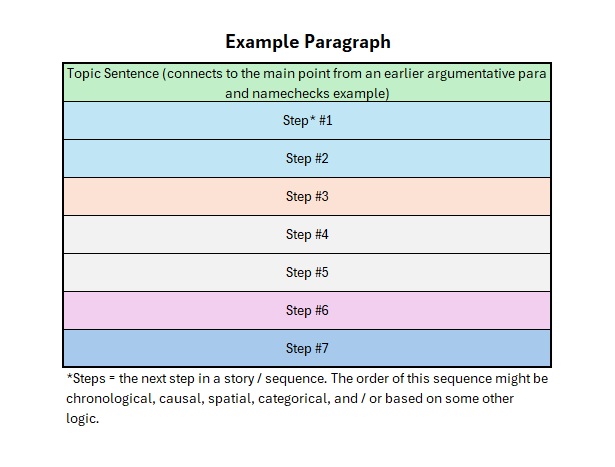
An example paragraph is a story or sequence: a topic sentence followed by a series of connected steps that show how one of your reasons work in the real world.
Like every body paragraph, an example paragraph opens with a topic sentence, followed by a single connected story rather than a loose collection of facts.
- Topic Sentence: The topic sentence has two jobs: 1) name the paragraph’s example, and 2) connect it to the main point made in the argumentative paragraph before it, by name-checking that point’s language.
- The Story: The rest of the paragraph walks through your steps in a clear way, each following logically from the last: a story describes a series of events in chronological order. An interview describes what each person said, in order. A process describes a series of causal steps, in order.
Key Insight: Example paragraphs differ from background paragraphs in that their steps are sequential. A background paragraph might share a date or name in one sentence and a location in the next. In contrast, An example paragraph’s steps each follow logically from the one before, and this logic is what makes an example paragraph function differently than a background paragraph. You may also remember that the layers of an argumentative paragraph (which has a “layer cake’ structure) depend on each other, but not typically in a sequential way. Argumentative paragraphs don’t usually read like “this happened, then this happened, then this happened…”, but that structure is extremely common for example paragraphs.
Sample Example Paragraph
We are staying with Alicia’s paper, picking up right where her argumentative paragraph left off. That paragraph argued that ratification turned suffrage into a right for the whole country. Now Alicia needs a concrete story that illustrates why a national right mattered, and she finds one in New Jersey: a state that gave women the vote, then took it back.
ALICIA’S PAPER
Topic: women’s suffrage
Thesis statement: The 19th Amendment was a crucial step forward for women’s rights.
Example she will discuss: New Jersey’s women’s suffrage history.
Main point being illustrated (her topic sentence, word for word): “The 19th Amendment was a crucial step forward for women’s rights because it turned suffrage from a privilege individual states could grant or revoke into a right for the whole country.”
Here is the paragraph she wrote:
New Jersey’s brief experiment with women’s suffrage illustrates why a right for the whole country was so important. In her study of election law in the early republic, historian Delia Marsh describes how “New Jersey wrote its first state constitution in 1776, extending the vote to any inhabitant worth fifty pounds, wording broad enough that most unmarried women and widows were qualified to vote” (Marsh 47). This quote shows the first step in New Jersey’s journey toward women’s suffrage. Women voted in New Jersey for the next three decades, openly and with the state’s full knowledge, and later election laws extended the practice to additional counties. Then, in 1807, after a county election clouded by accusations of fraud, the legislature passed an ordinary statute that barred women from the polls, ending the right without a constitutional amendment, a court ruling, or a vote of the people. Full voting rights did not come back to New Jersey women for another one hundred and thirteen years, until the 19th Amendment made suffrage a right for the whole country, beyond the reach of any single state legislature.
Here is how she built it:
The colors in the left column match the highlight colors in her paragraph above.
| Topic Sentence: Named Example |
She names New Jersey outright, in the first four words. Rationale: This is the subject of the paragraph, so a reader should not have to wait for it, and every event that follows is understood as part of that one case. Without it, a reader has a point being argued but no idea what is being used to prove it. |
| Topic Sentence: Connected Main Point |
She lifts “a right for the whole country” straight from her argumentative paragraph. Rationale: The phrase is word for word from that paragraph’s topic sentence, so there is no ambiguity about which claim New Jersey is proving. Without it, a reader has an interesting piece of history but no reason it is in the paper. |
| Event 1 | She lets Marsh open the story, quoting her on the 1776 wording that let women vote at all. Rationale: This first step is a full quote structure built with the ICE Method: she introduces Marsh by name, cites a direct quote tagged with an MLA ITC, then explains that the quote is the first step in New Jersey’s journey. Opening with her source also tells the reader where the whole sequence came from, and a reader has to believe the right was real before they can care that it was lost. |
| Event 2 | Next she establishes that this went on for decades, in plain view. Rationale: A skeptical reader might assume a few women slipped through by accident. Three decades of open voting, with later laws widening the practice, closes that door. |
| Event 3 | Then comes the turn: one ordinary statute, and the right is gone. Rationale: This is the moment the whole example exists to deliver, so she keeps it stark. No constitutional amendment, no court ruling, no vote of the people. |
| Event 4 | She finishes by putting a number on what that loss actually cost. Rationale: One hundred and thirteen years makes the damage concrete, and ending on “a right for the whole country” hands the reader back to the point she set out to prove. |
Next Steps
Example paragraphs are usually the last piece you write for a given point, after a background paragraph sets the context and an argumentative paragraph makes the case: Background Paragraphs and Argumentative Paragraphs.