|
RELATED PAGES The Lego Model | Body Paragraphs | Topic Sentences | Topic Sentences: Varsity Level | Background Paragraphs | Example Paragraphs | The ICE Method | MLA In-Text Citations (ITCs) |
What Is An Argumentative Paragraph?
Argumentative paragraphs are the core of your essay or paper. This is where you present the main points, each one a reason your claim is true, backed by reasoning, analysis, and evidence.
Purpose: Each argumentative paragraph makes one main point, which is a reason your claim is true (or, in the rarer case of a paragraph handling a counterargument, a reason it is not), explains that point through supporting points, and backs it up with evidence drawn from your sources. For this reason, argumentative paragraphs always support the claim in your thesis statement, not just the general topic of the paper.
Placement: Argumentative paragraphs make up the bulk of your essay or paper, and they generally begin once the reader has enough context to follow the argument, which usually means after your background paragraphs. Plan on one argumentative paragraph per main point. If a particular main point requires context a reader will not already have, place a background paragraph immediately before it.
Paragraph Structure
“Layer Cake”
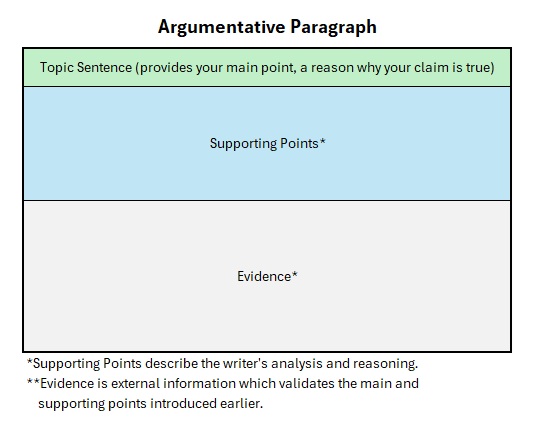
Argumentative paragraphs have the most rigid structure of the three body paragraph types, because each part depends on the part above it.
Where a background paragraph throws ingredients into one pot in any order, an argumentative paragraph is built in layers, bottom to top, and the layers cannot be swapped around. Evidence makes no sense before the reader knows what it is evidence for.
- Topic Sentence: Like every body paragraph, an argumentative paragraph opens with a topic sentence, and this one has two jobs: 1) state the main point that the paragraph will argue, which is a reason the claim is true, and 2) connect that main point back to the thesis statement by repeating, or “name-checking,” the claim.
- Supporting Points: Next come the sentences that carry your analysis and reasoning. Supporting points break the main point down, explain the thinking behind it, and show the reader why the main point makes the claim more believable. This is your voice, not your sources’.
- Evidence: Finally, you validate the main and supporting points with external information: data, statistics, quotes, and paraphrase from your research. Evidence belongs inside a quote structure built with the ICE Method (Introduce, Cite, Explain), and every Cite step must carry an MLA ITC.
Key Insight: Two things tend to go wrong with a layer cake. Some writers state a main point and jump straight to quotes, so the reader has to guess how the evidence proves anything. Sources can confirm your reasoning, but they cannot do your reasoning for you. Others reason well and never bring in evidence, so the paragraph never becomes more than opinion. Build all three layers, in order, every time.
Sample Argumentative Paragraph
We are staying with Alicia’s paper, picking up right where her background paragraph left off. Now that her reader knows what suffrage is and why the campaign dragged on for seventy years, she can start arguing. She opens with a topic sentence, works through her supporting points in her own voice, and only then brings in evidence. That evidence is delivered in quote structures built with the ICE Method, and each Cite step is tagged with an MLA ITC. Her real ITCs would name an author and a locator; here they are shown as “(citation)” so the focus stays on the paragraph.
ALICIA’S PAPER
Topic: women’s suffrage
Thesis statement: The 19th Amendment was a crucial step forward for women’s rights.
Main point for this paragraph (a reason the claim is true): Ratification turned suffrage from a state privilege that could be revoked into a permanent national right, and that permanence is what makes it “crucial” rather than incremental.
She has several main points to work through, but this one comes first, because it follows directly from the context she just gave her reader. Here is how she built the layers:
| Topic Sentence | Rationale: Her topic sentence states the specific reason this paragraph argues, that ratification converted suffrage from a right individual states could revoke into a permanent national one, and then name-checks “was a crucial step forward for women’s rights” word for word from her thesis, so the connection is unmistakable. |
| Supporting Point #1 | Why the old system was fragile. Rationale: Her reader knows voting rules belonged to the states, but not what that meant in practice. This is her reasoning about why a right any legislature could revoke was never a secure one. |
| Supporting Point #2 | Why the amendment fixed that. Rationale: The contrast is the argument. Having shown how easily the old system could be undone, she now explains why a permanent, national right cannot be, which is exactly the reasoning that makes “crucial” hold up. |
| Quote Structure #1 | A historian on permanence. Rationale: A direct quote from a scholar confirms her reading of what ratification actually secured. Introduce names the source, Cite quotes it and tags it, Explain ties it back to the word “crucial.” |
| Quote Structure #2 | The numbers. Rationale: Paraphrased data shows how fast and how completely that permanence reached every state. Paraphrase is still evidence, so it still needs all three ICE steps and an ITC. |
The sources named below are invented for this example. Do not cite them.
Here is the paragraph she wrote.
| Topic Sentence job one |
Green marks the sentence that states the paragraph’s main point: the reason this part of the claim is true. |
| Connection to Claim job two |
Yellow marks the name-check: the claim from her thesis statement, repeated word for word. |
| Supporting Point #1 – Supporting Point #2 | Her supporting points: analysis and reasoning, in her own voice. |
| Quote Structure #1 | Her first quote structure. Bold is Introduce, underline is Cite, plain text is Explain. |
| Quote Structure #2 | Her second quote structure, marked the same way. |
The 19th Amendment was a crucial step forward for women’s rights because it turned suffrage from a privilege individual states could grant or revoke into a right for the whole country. Under the old arrangement, a legislature that granted the vote today could repeal it tomorrow, and a win in one state did nothing for a woman in the next. Ratification of the 19th Amendment ended that vulnerability for good. Once the right was written into the Constitution, no state legislature could revoke it, which is exactly the kind of permanence a crucial right deserves. In her study of the ratification fight, historian Marla Chen argues that permanence, not just access, was the amendment’s real achievement, writing, “For the first time, a woman’s right to vote did not depend on the goodwill of a legislature that could change its mind” (citation). Chen’s point is that the amendment did more than expand who could vote; it removed the possibility of that right being taken away. That security is what separates a crucial gain from a temporary one. The durability and power of this approach are evident in the course of events after the Amendment was passed. A report from the Institute for Civic History notes that only fifteen states had granted women full voting rights before 1920, but all forty-eight guaranteed it, without exception, within the following year (citation). No state campaign had ever locked in a right so quickly. Seventy years of state-by-state organizing had chipped away at the problem one legislature at a time; the amendment made it permanent everywhere in a single stroke.
Alicia starts with her topic sentence, and it is doing two jobs at once. The green portion states her main point for this paragraph: permanence, not access, is what makes this step crucial. The yellow portion is the connection to claim, lifting was a crucial step forward for women’s rights straight from her thesis, word for word, so a reader can see immediately which part of her argument this paragraph carries.
With the main point on the table, she turns to her supporting points, and this is where the real arguing happens. First she establishes the problem: under the old system, a state could grant the vote and a later legislature could just as easily take it back, so no gain was ever secure. Then she explains the fix: once the right was written into the Constitution, no legislature could touch it. Neither sentence cites a source, because neither one needs to. This is Alicia’s own reasoning, in her own voice, and it has to come before her evidence, or a reader would have no way of knowing why the quotes that follow matter.
Only now does she bring in her sources. Her first quote structure introduces historian Marla Chen and her study of the ratification fight, so the reader understands why Chen’s judgment is worth citing. The quote itself argues that a woman’s right to vote no longer depended on any legislature’s goodwill, and it is tagged with an ITC. Alicia then explains the quote in her own words, tying it directly back to “crucial”: permanence, not just access, is what separates a real gain from a temporary one.
Her second quote structure repeats the same three moves with data instead of a direct quote. She introduces a report from the Institute for Civic History, cites its specific numbers (fifteen states before 1920, forty-eight within the year) with an ITC, and explains what those numbers prove: no state-by-state campaign could have matched that reach or speed. Paraphrase does not get to skip the ICE Method; it still needs an introduction, a citation, and an explanation, exactly like a direct quote does.
None of these pieces are interchangeable. Put either quote structure ahead of the supporting points, and the reader hits evidence before knowing what it is supposed to prove. Drop the topic sentence, and the whole paragraph loses its connection to the thesis. Each layer depends on the one built underneath it.
Next Steps
Argumentative paragraphs do the arguing. The last of the three body paragraph types does the illustrating: Example Paragraphs.