▶Prep Guide
This guide will help you develop a research question, gather sources, and build toward a concrete, actionable proposal. Read through carefully before you begin your research.
What Is the Moonshot? | Your Proposal | Current NVC Work | Part 1: Research Question | Part 2: Research & Materials | Next Steps
▶Key Resources
→ NVC Strategic Plan 2024–2026 — NVC’s Moonshot goal, Strategic Vistas, and institutional commitments.
→ NVC Moonshot Research Guide — Databases, data tools, and curated sources for this assignment.
What Is the Moonshot?
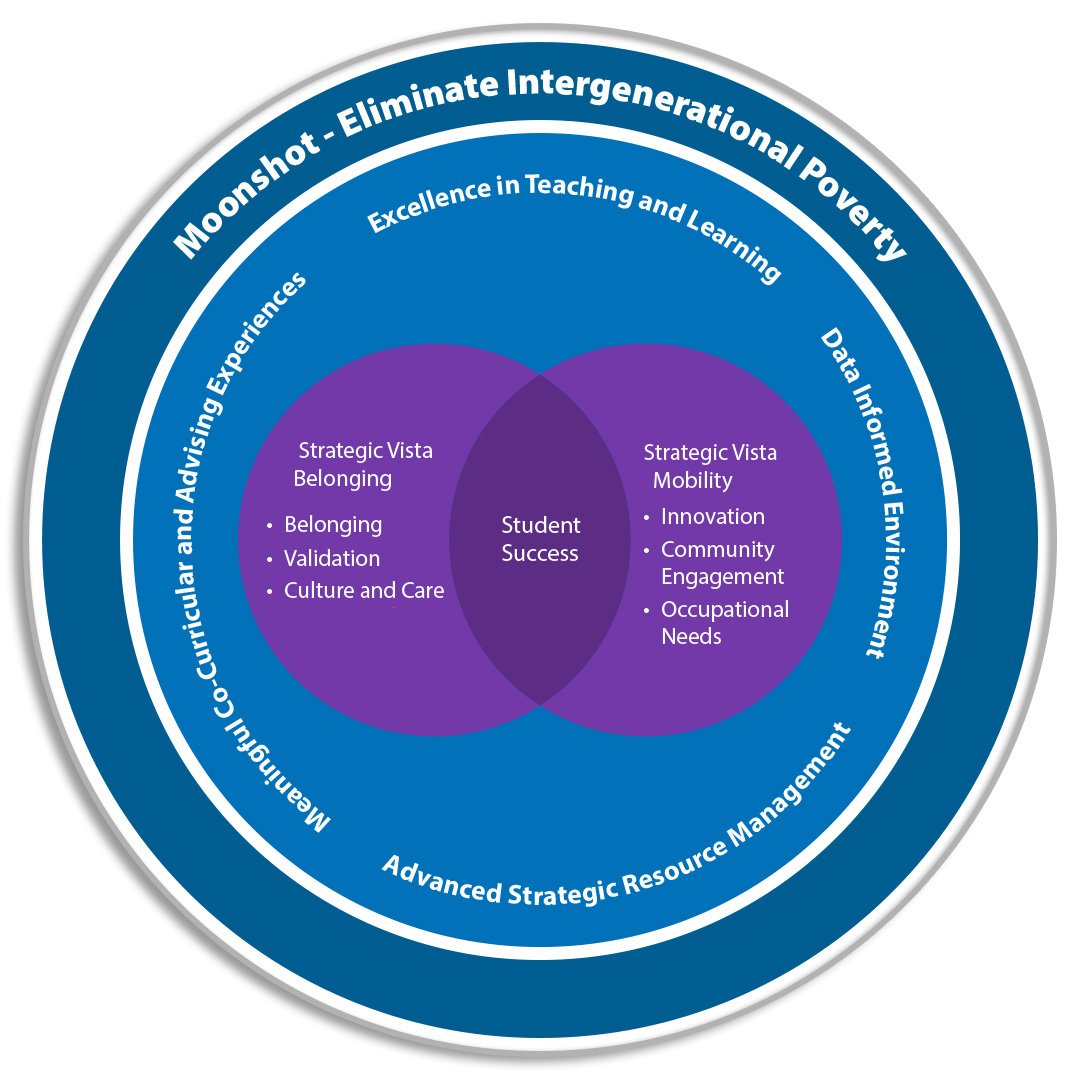
Northwest Vista College’s 2024–2026 Strategic Plan names a bold, defining goal: to eliminate intergenerational poverty through education and empowerment in the Greater San Antonio region.
NVC calls this its “Moonshot” — borrowing the term from the monumental effort that put astronauts on the moon in 1969 and applying it to an equally ambitious challenge here at home.
The need is urgent. San Antonio is one of the most economically segregated major cities in the United States. Roughly 17.7% of San Antonians live below the poverty line — well above the national average of 12.5% — and that poverty is not distributed evenly.
It concentrates in specific neighborhoods along racial and economic lines, a pattern rooted in decades of redlining, discriminatory housing covenants, and unequal school funding. Children born in the city’s most distressed zip codes can expect significantly lower lifetime earnings than children born just miles away in more affluent areas. For many families, poverty is not a temporary setback but a condition inherited across generations.
Poverty in San Antonio vs. Texas and the U.S.
Percentage of residents below the poverty line & median household income
Poverty Rate
San Antonio
Texas
United States
Median Household Income
San Antonio
United States
Sources: U.S. Census Bureau, American Community Survey 5-Year Estimates (2018–2022); City of San Antonio Status of Poverty Report (2024).
The chart above illustrates two sides of the same problem. San Antonio’s poverty rate is more than five percentage points above the national average — but the city’s median household income also falls roughly $15,500 below the national median, even though employment rates here are slightly higher than average. That gap tells a critical story: many San Antonians are working but not earning enough to escape poverty. This is the “working poor” dynamic, and it is one of the key mechanisms through which poverty passes from one generation to the next.
Your Proposal (Thesis Statement)
For your research paper, you will make a concrete recommendation to help the San Antonio community reduce or eliminate intergenerational poverty. Your thesis statement will express that recommendation as a clear, arguable claim — a specific proposal that someone could reasonably debate. The body of your paper is where you will develop the evidence, reasoning, and implementation details that support your proposal and demonstrate how it could realistically be carried out.
Remember that a strong argumentative thesis is debatable (not a simple statement of fact), specific (focused on a particular aspect of the problem), and concise (expressed in a single sentence). For a refresher on crafting thesis statements, review the Lecture Notes: Argumentative Thesis Statements.
Current NVC Work
NVC is already working on this — and you can build on that work.
NVC’s strategic plan is organized around two “Strategic Vistas” — think of them as big-picture commitments. The first focuses on creating welcoming, affirming environments where students develop a sense of belonging and critical consciousness. The second positions NVC as a social driver — an institution that builds partnerships, creates career pathways leading to family-sustaining wages, and works to serve the broader Westside community. Together, these vistas frame everything the college does as part of the larger effort to break the cycle of poverty.
You can review the full NVC strategic plan. The plan’s language around “structured servingness,” K-12 and university partnerships, family-sustaining wages, and community engagement may spark ideas for your own proposal. You are welcome to propose something that adds to or extends NVC’s existing efforts — an enhancement to student services, a new partnership, or a program the college has not yet tried. You are equally welcome to propose actions directed at the broader San Antonio community — initiatives involving employers, city government, nonprofits, neighborhoods, or other institutions. Your proposal does not need to be limited to what NVC can do on its own.
A Note on Scope
You are not expected to solve intergenerational poverty in a single paper. You are expected to identify one piece of the puzzle, research it thoroughly, and make a clear, evidence-based recommendation. Think of your paper as contributing one concrete idea to NVC’s larger Moonshot effort.
Part 1: Developing Your Research Question
Before you can write a thesis, you need a well-formed research question. A good research question is specific enough to investigate thoroughly in the scope of this paper, but open enough to allow you to discover something meaningful. It should point you toward evidence, not just opinions.
Start with What You Know — and What You Want to Know
Intergenerational poverty is a complex, multi-dimensional problem. Research from the National Academies of Sciences identifies at least seven major areas that drive whether a child born into poverty will remain in poverty as an adult: education and skills, child and maternal health, family income and employment, family structure, housing and neighborhood conditions, neighborhood safety and criminal justice, and child welfare. You do not need to address all of them. In fact, the strongest proposals tend to focus on one well-defined area and go deep.
Think about what aspect of this challenge resonates with you. Are you drawn to education and workforce development? Housing access? Health care? Financial literacy? Community investment? Childcare as a barrier to degree completion? Start where your curiosity lives.
Narrowing Your Focus
A question like “How can we end poverty?” is too broad to be useful. Try to move from the general to the specific by asking yourself who you are trying to help, what specific barrier or opportunity you are focused on, and where (NVC? San Antonio’s Westside? A particular population?). Here are some example research questions to illustrate what a well-scoped question might look like:
- What kind of emergency financial support program could NVC implement to reduce dropout rates among students who are single parents?
- How could expanded partnerships between NVC and local employers in health care create more direct pathways from certificate programs to family-sustaining wages?
- What would a community-based financial literacy program look like if it were designed specifically for first-generation college students in the Westside neighborhoods NVC serves?
- How have other community colleges successfully connected students to affordable housing resources, and what could NVC adapt from those models?
- What role could NVC’s alumni network play in building a mentorship pipeline that helps current students navigate the transition from education to career?
- How could free or subsidized public transit access for NVC students improve retention and completion rates?
Notice that each of these questions already suggests a direction for a proposal. They are not neutral survey questions — they lean toward solutions, which is exactly what your paper will ask you to provide.
Potential Directions for Proposals
These are starting points, not an exhaustive list. Your proposal can focus on actions NVC could take, actions in the broader community, or a combination. Consider areas such as:
|
Workforce & Career Pathways Apprenticeships, employer partnerships, certificate-to-career pipelines, sectoral training in high-demand fields. |
Student Support Services Emergency aid, childcare expansion, transportation access, food pantries, mental health services. |
|
Financial Empowerment Financial literacy programming, micro-savings accounts, tax preparation assistance, asset-building initiatives. |
Housing & Neighborhood Affordable housing advocacy, neighborhood investment, mixed-income development, housing voucher access. |
|
K-12 & Community Partnerships Dual credit expansion, college readiness programs, mentorship pipelines, family engagement initiatives. |
Health & Well-Being Healthcare access for students, campus wellness programs, addressing food deserts, maternal and child health. |
|
Community Engagement Alumni networks, civic participation, local business partnerships, service-learning tied to poverty reduction. |
Policy & Advocacy Living wage campaigns, public transit expansion, reform of exclusionary zoning, equitable school funding. |
Part 2: Research and Gathering Materials
Because your paper is a proposal, your research should do more than describe a problem — it should seek out evidence for solutions.
As you gather materials, look for examples of programs that have worked elsewhere, data that quantifies the need for your recommendation, expert perspectives on what approaches are most promising, and information about costs, implementation, and feasibility. The strongest proposals anticipate counterarguments and address practical realities. “This is a good idea” is not enough — you should aim for “this is a good idea, here is the evidence, and here is how it could be done.”
Source Requirements
Minimum Sources for Your Paper
✓ One interview source. This can be a firsthand interview you conduct yourself — with a professor, a community leader, a family member, a fellow student, or anyone with relevant experience or expertise. Third-party interviews (published interviews, podcasts, recorded testimonials) also count. An interview helps ground your proposal in lived experience and real-world perspective.
✓ Two sources from the NVC Moonshot Research Guide. The library has built a dedicated guide with databases, articles, data tools, and curated websites specifically for this assignment. These are your starting point for credible, academic, and data-driven sources. (See link below.)
✓ Additional sources are encouraged. You may use any credible online or print sources beyond the two required from the research guide. Government reports, news journalism, academic studies, nonprofit publications, and organizational data are all appropriate. Evaluate your sources carefully for credibility and relevance.
Getting Started: The NVC Moonshot Research Guide
Your most important resource is the NVC Moonshot Research Guide. Built by NVC librarians specifically for this project, the guide gives you databases, data tools, and curated sources in one place. Spend time exploring it before you commit to a research question — let your question emerge from what you discover. Key pages include:
✓ Welcome — Suggested search terms (“income inequality,” “food insecurity,” “housing insecurity,” “economically disadvantaged”) and tips on using Boolean operators and quotation marks to search effectively.
✓ Resources — Library databases for finding peer-reviewed articles, journalism, and other credible sources.
✓ Policy Map — An interactive data tool for exploring poverty, employment, housing, and education data at the neighborhood level. Especially useful if your proposal targets a specific geographic area.
✓ NVC Demographics & Stats — Data on who NVC students are — critical context for any proposal that involves the college.
✓ Income Inequality & Housing Discrimination — Curated sources on two major drivers of intergenerational poverty in San Antonio.
✓ Evaluating & Citing — How to assess source quality and format your citations correctly.
Next Steps
Once you have a research question that excites you, draft a preliminary thesis — a one-sentence statement of what you will propose — and begin gathering sources that support, complicate, and strengthen your argument.
This project is about more than a grade. NVC’s Moonshot is a genuine institutional commitment to one of San Antonio’s most pressing challenges, and your research contributes to that effort. You are being asked to think seriously about your community, to listen to people whose experiences inform the problem, and to propose something concrete. That work matters. Approach it with curiosity, rigor, and a belief that your ideas have value.